

Celebrating 60 Years of Meals on Wheels
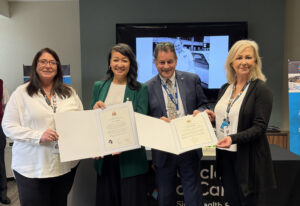
Toronto city councillors Lily Cheng and James Pasternak present scrolls of congratulations on the 60th anniversary of Meals on Wheels.
On November 16, Circle of Care welcomed volunteers, staff, community partners, supporters, and elected officials to celebrate a remarkable milestone: the 60th anniversary of Meals on Wheels.
The afternoon recognized six decades of service, community, and care, while reflecting on the vision that transformed a small pilot project into one of the largest Meals on Wheels programs in Canada.
In her opening remarks, Carey Lucki, Chief Executive Officer at Circle of Care, reflected on the program’s lasting purpose.
“The true measure of Meals on Wheels is not the number of meals delivered,” she said. “It’s what those meals make possible. They help people remain in the homes they love. They support family caregivers. They reduce isolation. They preserve dignity. And they help some of our community’s most vulnerable members, including many Holocaust survivors, age with comfort, security, and connection.”
That commitment to helping people remain independent and connected has been at the heart of Meals on Wheels since 1966, when the National Council of Jewish Women, together with several Jewish community organizations under the auspices of the United Jewish Welfare Fund, launched Kosher Meals on Wheels to support seniors living at home.
“It’s such an incredible milestone,” expressed Willowdale Councillor Lily Cheng. “What began as a big vision and dream is now an incredible operation. Getting all those meals out is not a simple task, especially when you consider our winter weather. Thank you to the staff and volunteers who are dedicated to this program because you care.”
In the early days, the program operated out of a tiny corner of Baycrest with two filing cabinets, a desk, a lamp, and a phone. Every evening, staff packed everything away. Every morning, they set it up again. There were no computers. Route sheets were written by hand. 40 volunteers delivered 50 meals a week on foot or by streetcar.
Those early staff and volunteers were laying the foundation for something that would grow far beyond what anyone could have likely imagined.
Today, Circle of Care’s Meals on Wheels program is one of the largest in Canada. With the support of more than 100 dedicated volunteers, we deliver more than 257,000 meals each year across Toronto and southern York Region.
York Centre Councillor James Pasternak spoke about the critical role volunteers and community organizations play in supporting residents across Toronto. “Volunteering is perhaps the most important thing we can do as individuals, because time is our most precious resource, and it’s also our most finite. Government cannot do it alone, and therefore we rely on agencies and the social capital of organizations like Circle of Care. Toronto must have shared values of helping those in need and making sure that seniors who built this great city are not forgotten.”
Many of the people we serve today are living with significant frailty. Some are managing chronic illnesses, mobility challenges, or cognitive decline. They can no longer shop for groceries independently or safely prepare meals on their own. Meals on Wheels gives them reliable access to nutritious food that helps maintain their health, strength, and independence.
Lisa Rae, Director, Volunteer and Community Programs, oversees the Meals on Wheels program. She closed out the event with a final thank you. “I want to thank the whole team; they do such hard work and it’s so appreciated. We’re also grateful for the partnerships that we have with our food providers. Sepha Foods and Aroma’s World Kitchen have been with us for many years and Bernard Betel is our newest provider. We’re appreciative of everything they do and for all of their support. And lastly I want to acknowledge all our volunteers for their compassion and dedication. You really are the backbone of the program and we truly appreciate that.”
While much has changed since 1966, the heart of the program remains the same: neighbours helping neighbours and a shared commitment to ensuring that people have the support they need to remain safe, nourished, and connected in their homes and communities.